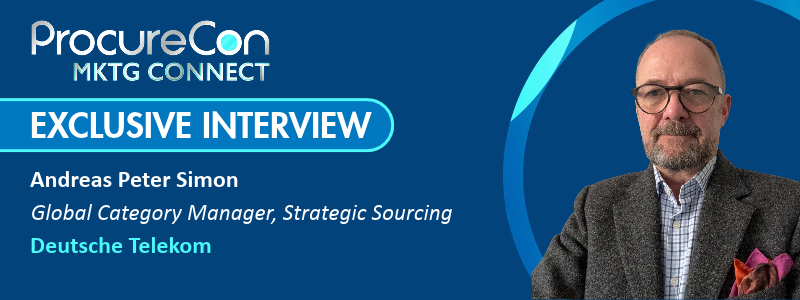
Exclusive Speaker Interview: Andreas Peter Simon, Deutsche Telekom
AI is dominating industry conversations. Where do you think procurement teams can create the most value with AI today, and where is the hype outweighing reality?
Let's take a step back. AI is not God given and not God driven. AI is the business model of some huge companies. There's enormous money behind it and those companies are urging corporations, individuals and societies. Although this is a different discussion, it's important to have that in mind as it has consequences.
Coming back to PROC: what I see in my broader surrounding is that everybody started to use AI regularly for work, but the coordination or orchestration of AI usage is currently lacking power. It is not really clear what the value added is. If we talk automation: that existed before.It was called software, template, automated workflow APPs (Mac's Automator since 2005!), etcetera. If we talk content creation the results are not God given either. They must be checked and double checked and adjusted to become robust and valuable. It doesn't replace thinking. If you don't know what PROC or negotiation story you want to tell, AI won't do it for you. In recent times we can see in every presentation some charts / dashboards created by AI. First, they look all the same, and in addition the numbers & information on such charts, are just numbers & information on charts without telling a powerful story that convinces the audience.
Looking at the supplier side, it is clearly unclear what exactly they're doing with AI. Creatives could be more creative, but only if the Creatives were already creative before. For process management the same applies as I said before. AI generated content like pictures and moving pictures still look artificial and the audiences have issues connecting with that. However: simply asking to participate in the suppliers' AI-Dividend brings money. Rather suspicious that is.
AI can be a huge value. But we must learn to define that value!
What's the biggest challenge marketing procurement leaders are facing right now that isn't being talked about enough?
One – for sure – is identifying the real added value of AI in the MARK-PROC process. The other one is pricing transparency as such, and tender readiness of the business sides to eliminate dependencies. Very often suppliers work on campaigns, bits and pieces, presentations, productions, ideas, etc., without having a clearly phrased and robust scope of work to start with. An Agency Brief is never replacing the shopping list! Of course, there are numerous internal discussions and complaints about this phenomenon. Yet, real discussions must start within 'The Holy Trinity' of PROC, Business and Controlling. The highest Value-Added is the only long-term contributor to the Share Value of Companies. It's not about making it cheap, it's about making it right!
How are agency relationships evolving, and what distinguishes high-performing procurement teams from those still relying on traditional sourcing approaches?
MARK-PROC will always be judged on their contribution to the business as such. As Agency Business is People's Business, the quality of the relationship can be a game changer for PROC-Contribution. As mentioned earlier: 'Cheap' was yesterday, 'Value-Added' is the game today. High performing PROC-Teams gain control to shape the daily changing future. €-Transparency and Cooperation-Transparency go hand in hand. The agency relationship must move from simple Supplier to trusted Business Partner.
As procurement becomes a more strategic business partner, what skills and capabilities do leaders need to develop within their teams?
It's easy: Empathy and the true understanding of the business. Both internal Business-Side, and Agency side.
Marketing budgets remain under pressure. How can procurement balance cost optimisation with supporting innovation, creativity, and long-term brand growth?
Being under pressure is the second nature of marketing budgets. Has always been. However, a deep understanding of market dynamics, agency operating models, talent-driven cost structures, and the increasing complexity of omnichannel communication is key. The challenge lies in balancing creative excellence with commercial transparency, ensuring competitive tension while fostering long-term partnerships, and navigating a supplier landscape shaped by consolidation, specialization, and rapid technological change.
Procurement starts in the head – not at the negotiation table!
Can you share an initiative or project that has delivered meaningful business impact, and what lessons could other marketing procurement leaders learn from it?
In the spirit of €-Transparency and Cooperation-Transparency, we have been using two very simple tools for a while already. One is our 'Target Costing Tool'; it challenges the rates proposed by the supplier for the six Skill-Levels we use to calculate the services rendered. This tool sheds light on the reality of the hourly rates proposed, based on the ingredients of yearly gross salary of a certain Skill-Level, related costs, overheads, profit margin, and billable hours. When showing the calculation real-time in a negotiation call, prices drop also in real-time.
The second tool is baptised 'Precision Scope Pricing' (PSP). Here the supplier is asked to define the precise Scope-Items in a project, define the precise deliverables, define the precise Skill-Levels needed, define the precise number of hours allocated. The granularity of this type of information creates a visible Cooperation-Transparency, which can be easily evaluated by both Business-Side and PROC.
The combination of both tools rocks!
What's one piece of advice you would give to marketing procurement leaders navigating today's rapidly changing landscape?
You must be both rigorous and adaptive: enabling innovation, safeguarding brand quality, and ensuring that every Euro invested in communication delivers measurable value for the Corporation.
For senior marketing procurement leaders considering attending ProcureCon Marketing Connect 2026, why would you recommend they join you?
I always experienced ProcureCon Marketing Connect not just as a simple networking event for industry peers but a very intense two-day exchange of valuable thoughts, insights, learnings. The different formats of the events keep you engaged, widen horizons, sharpen perspectives. The exchange of thoughts and ideas, both with PROC-People and Suppliers, is inspiring. And the best thing: you soon discover that you are not the only one with certain challenges, and specific question marks! Same, same, but different.
Andreas will be joining us at ProcureCon Marketing Connect 2026, alongside other senior marketing procurement leaders.
Download the agenda to explore the full speaker line-up, sessions and networking opportunities.